Sunday, January 27, 2013

Failure is Inevitable


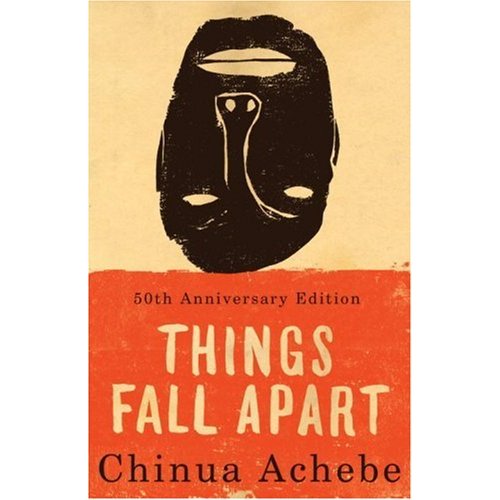
In the novel “Things Fall Apart” by Chinua Achebe, Okonkwo strives to become everything his father Unoka was not, a weak failure. However, as the novel unravels, it is apparent that failure is an inevitable aspect of human nature.

Unoka, Okonkwos father, died a failure; he never managed a successful harvest and proved deficient in providing for his family.  Okonkwo’s passion was to not have the same fate as his father, and embody the qualities of gentleness and idleness.

“Okokokwo [also] wanted his son to be a great farmer and a great man. He would stamp out the disquieting signs of laziness which he thought he already saw in him” (Achebe 33). Despite trying to be masculine in the eyes of his father, his weak feminine qualities were unavoidable. This is apparent as Nwoye is listening to his father’s masculine stories of the land of bloodshed and violence and he “knew that it was right to be masculine and to be violent but somehow he still preferred the stories that his mother used to tell” (Achebe 53).


Despite Okonwo’s efforts, he falls into the doomed light of his father, Unoka. His exile from his village in Umofia for his inadvertent murder of a teen boy is one sign of this. This shows how even the most powerful men cannot journey through life without running into obstacles. Similarly, despite okonkwos hatred for feminism, he is living in exile in his motherland. As Ofeudu, Okonkwos uncle, says, “when there is sorrow and bitterness, [a man] fins refuge in is motherland” (Achebe 134). This shows how the feminine side of every person is inexorable in their nature.  In addition, even though Okonkwo values never giving up, his suicide is a sign that he gave up fighting to preserve his religion and remove the Christians from his country. 

Wednesday, January 16, 2013

Are men really more powerful than women?


Differences in gender roles is apparent in modern society and is a significant theme throughout Chinua Achebe's novel, "Things Fall Apart". In Ibo culture, women are subservient towards the male authority. Patriarchy has manifested itself in the social, legal, political, and economic organization of Ibo culture.

It is implied that women are in some ways viewed as property for men in Ibo culture. This is reflected by the fact that men would purchase his wives. Once married, the man has control of everything, including the children. The idea of love and connection between man and wife was not how the ibo people define marriage. Many Ibo women do not really love their husbands but instead have a sense of fear towards their husbands. These women have little to no value of their own.

In addition, the men in Ibo society are not hesitant to beet women for minor circumstances. Okonkwo gave his second wife, Ekwefi, a sound beeeting for merely cutting a few leaves from a banana tree to wrap some food. Shorthly thereafter, he "nearly killed [her] with his gun" (Achebe 48).  In another circumstance, a woman and her husband, Uzowulu, were at trial because "no day passed in the sky without his beating the woman" (Achebe 91).

Male dominance is also reflected in the Ibo ways of farming. While the women grow crops like coco-yams, beans, and cassava, "Yam, the king of the crops, was a man's crop" (Achebe 23). In Ibo culture, yam is symbolic of masculinity. The more plots of yam farms a man owns the wealthier he is and  he has a better chance of keeping his family feed and devoid of starvation and famine.
How people even today perceive men in comparison to women

Differences in gender roles are still aparent in modern society world wide, however to a lesser extreme. Simlar to Ibo society, women today are expected to be housewives that clean, cook, and take care of children while men go to work.


Thursday, January 10, 2013

The Danger of a Single Story


Chimanda Adichie's TED talk on "The Danger of a Single Story" has broadened my perspective of society and individuals. It made me realize that we have all fallen victim to stereotype's that have been influenced from the media. Our tendency to label people based on the an overemphasized single story of their ethnicity impedes us from identifying their individual personality.

Similarly, I learned from reading this video to not judge something before learning the story behind it. At first I assumed that the video on Chimanda Adichie's TED talk focuses on literature, however I was mistakend. It instead tackld a moral lesson, to avoid 

Adichie's talk influenced my approach on how I read Chinua Achebe's novel, Things Fall Apart. I tried to clear my mind from the single story of Africans' as living underprivileged lives under unsuitable conditions. Adichie's TED talk remained in the back of my mind as I read the first four chapters of Things Fall Apart. I began to develop distinct views on each character as I read these chapters, I realized that the moral behind Adichie's talk enabled me to realize that Ukonkwo and his father, Unoka, are direct opposites of each other; while Okonkwo was motivated to succeed and to be fierce, his father was an idle and gentle man. In fact, "Okonkwo was ruled by one passionto hate everything that his father Unoka has loved" (Achebe 13). 


Wednesday, November 28, 2012

The Most Tragic Element of Hamlet


Shakespearean tragedies are five act plays that revolve around the downfall of a heroic figure whose death affects the welfare of the empire. The hero’s sudden reversal of fate and tragic flaw leads to his downfall. The protagonist struggles with external and internal conflicts as he undergoes abnormal physiological conditions. Shakespeare incorporates supernatural beings, such as ghosts or witches, in order to add to the excitement of the plot. He increases interest in his plays through the use of contrast. For instance, before a tragic scene, he incorporates comic relief in order to balance out the audience’s emotions. Shakespeare also includes characters that provide contrast to the protagonist. http://kilby.sac.on.ca/faculty/KRAMON/English/Grade%2010%20Files/Macbeth%20Files/Characteristics%20of%20a%20Shakespearean%20tragedy.htm

What separates Hamlet from other tragedies is his delay in taking action to avenge his own father’s murder. He says he wants to “know a thou a more horrid hent” (3.3.93). Hamlet reasons that he should find a better moment to murder Claudius and should not murder him as he prays because he is concerned he will send his soul to heaven. This contrasts Laertes’s willingness to “cut [Hamlet’s] throat in church” (4.7.144) in order to avenge his fathers death. The fact that Shakespeare has Laertes and Fortinbras’s characters active in their steps towards revenge unlike Hamlet, agrees with Shakespeare’s style of including characters that provide contrast to the protagonist. In addition, like every tragedy hero, Hamlet's flaw works against him; he excecively thinks things through, which delays his revenge. 

In my opinion, I consider Hamlet's death the most tragic aspect of the play. I feel sympathetic for Hamlet because he is betrayed by all of his friends and relatives except Horatio. In my perspective, because he has an innocent personality, he is hesitant and afraid to take revenge. Even after he completes his deed, he dies and is not rewarded by getting what he deserves, the crown to the thrown. 

Thursday, November 8, 2012

To Be or Not To Be

Hamlet's "To Be or Not to Be...." (3.1.64-99) soliloquy is one of Shakespeare most prominent works. Till this day, experts on Shakespeare, including Michael Almereyda and Franco Zefferelli, have come up with different interpretations of this monologue.

http://www.youtube.com/watch?v=-YHMYkUrV7A
Almereyda's modern interpretation, takes place in a vacant Blockbuster store. As Hamlet walks down the aisle of action movies, it draws a line to Hamlets struggle to take the first step to avenge his fathers murder. The film playing in the background connects to the central theme of the soliloquy in that it references to death.

http://www.youtube.com/watch?v=jdp6dpiK8Ko
In my opinion, I prefer Zeferelli's interpretation of this soliloquy because it is a more purist version than Almereyda's play. Mel Gibson, who plays Hamlet, appears to be more consumed in his mind than modern Hamlet. As he performs this soliloquy in his fathers tomb, it is apparent he is repenting his fathers death.

Thursday, November 1, 2012

Rogue and Peasant Slave

     After hamlet delivers his "rogue and peasant slave" soliloquy, it is apparent that he has transformed from a passive to an active character. Hamlet wants to uncover the mystery behind his fathers murder because he is concerned that the ghost may be a devil is disguise.

     One quote in particular caught my eye in Hamlets soliloquy that followed the meeting the meeting of the actors. In the quote "What's Hecuba to him, or he to Hecuba, / That he should weep for her? What would he do / Had he the motive and the cue for passion / That I have?" (2.2.585-588), Hamlet aspires the passion the actor possesses. Hamlet criticizes himself for his inability to avenge his father's murder. He feels guilty that that actor can passionately cry his heart out for a fictional character and he himself has not taken the first step to avenge his fathers murder.  It is apparent that Hamlet wants to think in terms of an ideal hero. The actors passionate speech stirs hamlets drive to take revenge for his father death.


Thursday, October 11, 2012

First Impressions of Claudius


When Claudius is introduced in 1.2, he comes across as a suspicious sovereign. Throughout his speech, he uses antitheses such as "mirth"(1.2.12) and "dirge" (1.2.12) to degrade his suspicious actions. He degrades the severity of his brothers death, the late king and Hamlet, and his marriage that soon followed his brothers funeral to his sister-in-law, Gertrude. For instance, he explains how he married Gertrude for the "better wisdoms" (12.2.15) of the country.  This makes me question whether or not he murdered his brother as a means to take the throne or for his love for Gertrude. He quickly diverges from this matter in his speech, and notes that he will send Voltimand and Cornilius to Norway to give a letter to the King, Young Fortinbras’s uncle. He explains how he hopes the King of Norway will use his power to hinder his nephews plans to instigate war as revenge for his fathers death and the conquest of Norway by the late Hamlet. He makes note of this in his speech to come across as a good ruler trying to create diplomatic relations. However, he suspiciously wants Fortinbras to follow through with his plans and start a war with his weak army that Claudius can he can easily overcome with his powerful army. I predict that Claudius will continue to be a suspicious character throughout the play and as the story climaxes, it will eventually be revealed whether or not he murdered his brother.